
How to Find Who Owns a Hamilton County Property
[PARAGRAPH - Research §7 + §10. The definitive route to the owner of a Hamilton County property, starting from an address or an owner name.]
- Find the right town roll and capture the owner exactly as printed.
- Use the deed reference or grantee name to find the newest transfer.
- For a New York entity, use the state Corporation and Business Entity Database.
- Treat the mailing field as a tax-contact address, not proof of residence.
Where Hamilton County Owner Information Comes From
Two records carry the ownership weight. The town assessment roll prints the CURRENT OWNERS NAME along with a mailing address, the APN, the situs, the tax description, and a deed book or page reference. For stronger evidence of the most recent recorded transfer, the County Clerk's newest deed is the document that actually proves it.
| Source | Owner Info It Gives | Access |
|---|---|---|
| Assessor / tax roll | Assessment lead plus separate owner mailing field | Posted town assessment-roll PDFs |
| Recorder deed index | Newest recorded conveyance found through SearchIQS or the Clerk | County information page; SearchIQS subscription terms apply |
| Secretary of State | State entity filing details where publicly available | New York business-entity search |
| GIS parcel viewer | CURRENT OWNERS NAME on the dated roll | County-authorized parcel map link |
Read both fields with care. An assessed owner can be an individual, a trust, an estate, an LLC, a public body, or another entity, and the mailing address may sit well outside Hamilton County. Neither field tells you who occupies the site.
What "Who Owns This Property" Cannot Tell You
The public record answers one narrow question. It names the owner of record. It does not confirm who lives at the property, and it is not a title search, since a full search reaches well beyond the newest deed. New York also applies owner privacy protections to certain records, so some details stay limited even in official files.
Lawful use. [1-2 sentences - a Hamilton County owner lookup is for property research and due diligence; using owner information to harass or intimidate anyone is a crime under New York law.]
The Hamilton County Roll Is the First Owner Lead
Hamilton County's posted town rolls make the ownership field easy to spot. It is labeled CURRENT OWNERS NAME. CURRENT OWNERS ADDRESS prints separately. One entry can also carry the tax-map number, the property location and class, legal-description clues, deed book and page, values, exemptions, districts, and grid coordinates. Start there. It ties the name to a particular town, parcel, and dated assessment record.
Pick the right town before anything else. Speculator is a village inside Lake Pleasant. An address bearing the Speculator name belongs in the Lake Pleasant roll. The remaining choices are Arietta, Benson, Hope, Indian Lake, Inlet, Long Lake, Morehouse, and Wells. An address search can come up empty. Try the road name, the owner, the APN, or a tax-description term instead.
The Hamilton County annual roll page lists every town's roll.
Save the roll year and the taxable-status date once you find the entry. Calling the printed name current without those two dates overstates what the record proves. Ownership can shift after any roll is filed.
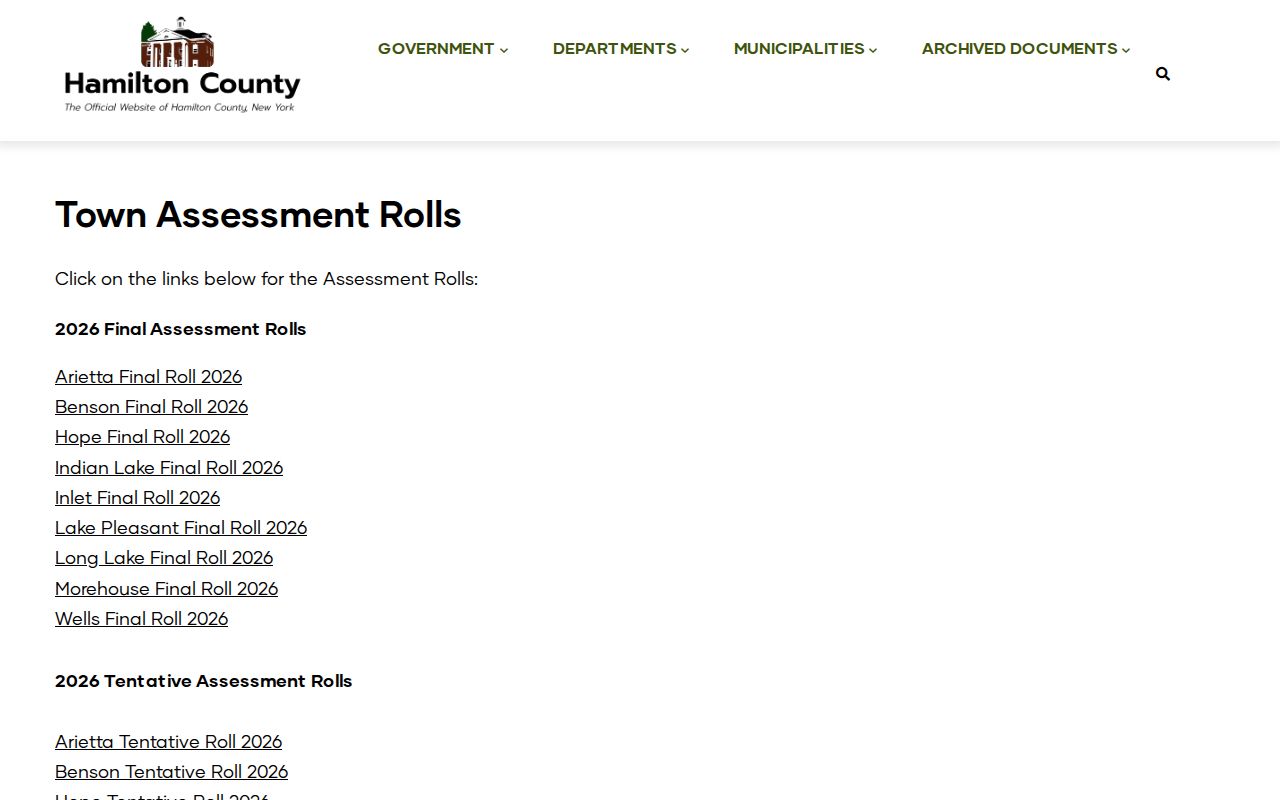
Note the roll year and the taxable-status date on any entry you rely on. A name printed without those dates may overstate what the assessment record actually proves about current ownership.
Confirm Who Owns a Hamilton County Property With the Newest Deed
The roll's deed book and page opens the County Clerk trail. Hamilton County routes online land-record users to SearchIQS. It posts subscription charges of $15 for one day and $25 for thirty days, with $0.65 per printed page. Open the referenced deed. Compare its grantee and legal description against the parcel. Then search for any later transfer. The county publishes no complete online start year. Contact the Clerk once the chain moves beyond the portal.
A deed can name an individual, multiple grantees, a trustee, an estate representative, an LLC, a public entity. Or it can name another ownership form. Keep the vesting language intact rather than shortening it to a familiar name. A New York LLC appears in some deeds. The Department of State Corporation and Business Entity Database can supply the entity record. That lookup does not change what the deed says about title.
The Clerk records far more than deeds. Mortgages, assignments, easements, rights of way, APA permits, surveys, subdivision maps, and liens all pass through the office. Judgments and probate-related land material do too. Companion instruments like these can explain a parcel's history. But do not mistake them for a later ownership transfer unless their language actually conveys land.
Owner, Mailing Address, and Occupant Are Different Facts
Many Hamilton County parcels are seasonal or waterfront. So their tax bills go to addresses far outside the county. That is ordinary. The situs field marks the assessed land. CURRENT OWNERS ADDRESS marks where the roll sends mail. Neither one says who sleeps there or has permission to occupy it.
Ownership research fits real needs. A purchase, an easement question, a boundary dispute, an estate history, or a tax issue all justify it. It is not a title search. It must never be used to stalk, harass, or target anyone. New York's Address Confidentiality Program gives eligible participants a substitute address accepted by agencies. Historical public records remain intact, though. Hamilton County publishes no official property-fraud alert enrollment page. Similarly named services from other states should stay out of a Hamilton County search. An unfamiliar instrument is a question for the Hamilton County Clerk listed on the county's official website.
Older parcels can hide from street searches. The tax description works better. Try the APN, survey number, subdivision, tract, gore, or deed reference. Hamilton County rolls keep terms like Survey 2227, Survey 1349, Oxbow Tract, Jones Gore, and Court House Lot. These anchors stay stable while names and mailing addresses shift over time.
Shared names demand comparison. Check co-owners, middle initials, mailing addresses, deed dates, and the legal description before matching anything. Resemblant owner text alone never justifies merging parcels. Estates and trusts may require the deed and probate trail before the ownership form can be stated accurately.
A sound answer names its source and date. Say a specified town roll lists an assessed owner as of its taxable-status date. Say the newest deed found through the Clerk names a stated grantee on its recording date. If the two differ, report the difference and look at later filings. Buyers, sellers, heirs, adjoining owners, and researchers all benefit from that restraint. It keeps a dated public record from becoming an unsupported title conclusion. Keep the roll excerpt and deed citation together. The pair shows both the assessment lead and the recorded transfer behind the ownership statement.