
Hamilton County Deed Records and What They Show
Every recorded deed in Hamilton County names the parties. It also gives the legal description and states the instrument type and the recording reference. But deeds are only part of the ledger. The County Clerk also accepts mortgages, assignments, easements, rights of way, surveys, subdivision maps, liens, judgments, and land-related probate papers. Each of those filings becomes part of the parcel's official record once it is recorded.
| Deed Type | What It Does | Common Use |
|---|---|---|
| Warranty deed | Warranty deed | Recorded conveyance between grantor and grantee |
| Quitclaim deed | Quitclaim conveyance without an assumed title conclusion | Quitclaim deed |
| Grant / special warranty | Bargain-and-sale or comparable deed language | Instrument wording must be read from the recorded deed |
| Trustee / executor deed | Executor, trustee, or fiduciary conveyance | Referee, executor, or fiduciary deed |
| Tax deed | Tax-related deed recorded by the Clerk | Tax deed |
A deed moves ownership. A mortgage, lien, assignment, or release changes the money and legal picture around the parcel instead. That difference matters when you read the records. Treat the filings as one continuous file rather than assuming every document is a sale, and the ownership history stays honest.
The Hamilton County Grantor-Grantee Index
[PARAGRAPH - Research §2. How the recorder's index is organized in Hamilton County and how to trace ownership through it.]
- Find the newest deed naming the current grantee.
- Record the grantor, date, book and page, and legal description.
- Find the grantor.s earlier acquisition as grantee and repeat.
- Ask the Clerk for older index books because no complete public online cutoff is stated.
- Grantor
- Grantor
- Grantee
- Grantee
- Chain of title
- Chain of title
- Book/Page vs Instrument #
- Book, page, instrument information, and recording date
Getting a Copy of a Hamilton County Deed
Copies come several ways. Subscribers can print the recorded image directly, and the counter handles walk-in requests. Mail orders work too. The fee is paid per page for either a plain or certified copy of the recorded deed. Certified copies carry the Clerk's authentication for transactions that require one.
Recorded, not guaranteed. [1-2 sentences - the Hamilton County deed index shows what was recorded; it is not a title opinion, and unrecorded interests can exist. A title search confirms clear ownership.]
Hamilton County Clerk Access, Prices, and Older Books
Online access runs through the County Clerk's official page. That page links to SearchIQS and posts three simple rates. A one-day subscription costs $15. Thirty days cost $25, and printing runs $0.65 per page. Confirm those charges before you subscribe. Terms change. The records room still matters for anyone hunting an older volume, a certified copy, or a record type the account interface does not reach. A trip in person may be the fastest route.
No official Hamilton County source states a single start year for the full online collection. A search that dead-ends at a date does not mean earlier deeds vanished. Ask the staff about grantor and grantee indexes, historical index books, deed books, survey files, and subdivision maps. Bring the town. Bring an approximate year, party names, book and page, and any legal-description wording you have.
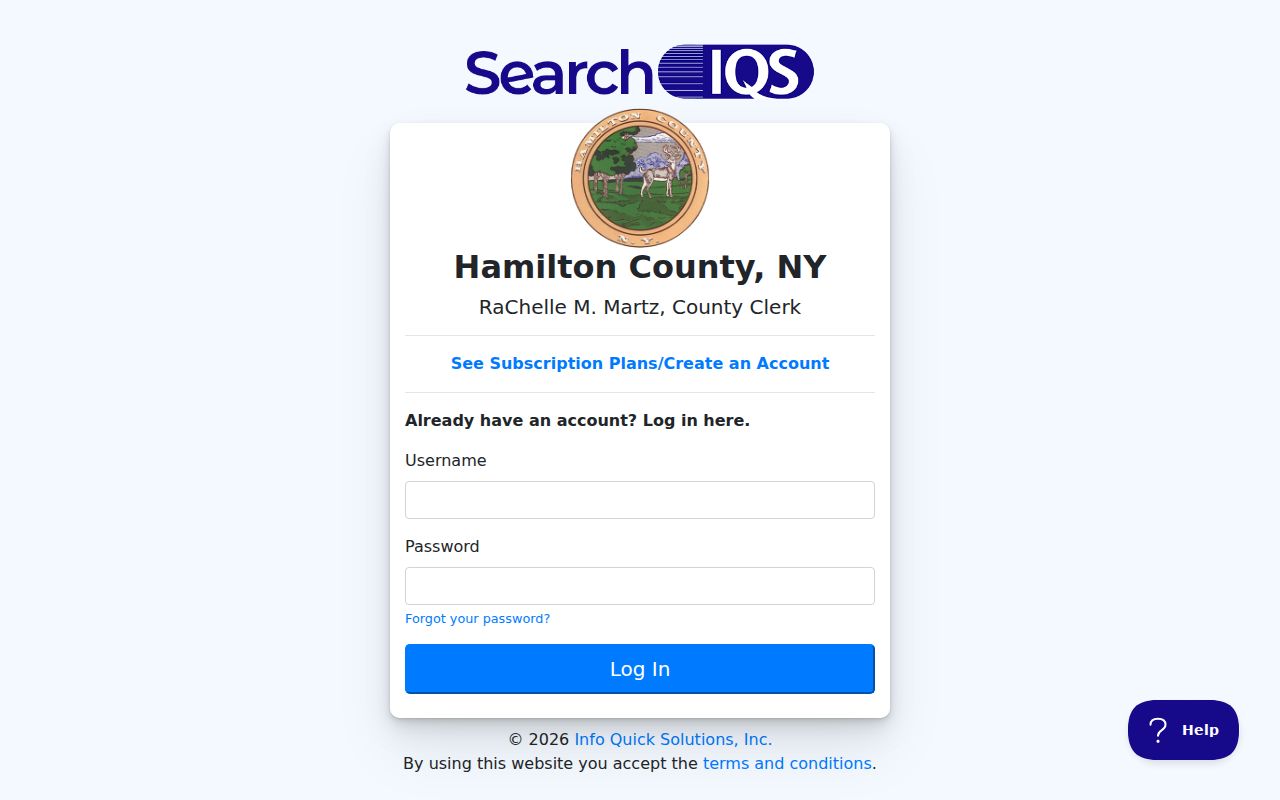
The Hamilton County SearchIQS login shows the account-based access point in practice.
Keep three things separate: the index hit, the image, and certification. An index entry locates the filing. The image supplies the actual language of the instrument. A certified copy is the Clerk's authenticated reproduction, reserved for transactions and proceedings that demand one.
Surveys, Easements, Mortgages, and Liens Around Hamilton County Deeds
A chain of deeds rarely explains every interest touching Adirondack land. The Clerk's recordings include mortgages and assignments. Easements and rights of way appear there too. So do APA permits, survey and subdivision maps, liens, judgments, powers of attorney, and probate instruments. Run the same party names and legal description against those companion records. A release or satisfaction can matter as much as the document that created the encumbrance.
Local wording gives you strong search clues. Entries for Lake Pleasant and Speculator carry Survey 2227, Survey 1349, Subdivision No. 1971, Oxbow Tract, Jones Gore, Court House Lot, Whispering Pines, Bearhurst, and South Shore phrasing. Copy the spelling, numbers, and abbreviations exactly as recorded. A street address can come later; an older deed may not contain one at all.
Probate can break a tidy buyer-to-seller pattern. The Clerk records probated wills and death certificates tied to land. Surrogate's Court files may fill in the estate details. A trust, executor, referee, or public body may stand in for an individual grantor. Follow the capacity stated in each instrument. Don't force every step into an ordinary sale.
What Hamilton County Deed Records Cannot Establish Alone
A recorded deed gives public notice, but a downloaded deed is not a title opinion. A deed search can miss plenty. Indexing variations hide instruments. So do estate interests, unreleased liens, off-record claims, and documents filed under a different legal-description form. The search also cannot place a boundary on the ground. Attorneys, title professionals, and licensed surveyors handle those questions. A careful Hamilton County deed search leaves them room to work.
Hamilton County publishes no official property-fraud alert enrollment page. Be wary of search results pointing to similarly named counties in other states. Those are not local services. An owner who spots an unfamiliar filing should contact the Hamilton County Clerk through the office's official county page. Provide the instrument reference.
An assessment roll can hand you a deed book and page quickly. Verify that citation against the Clerk's record before relying on it. A roll sometimes carries an older acquisition reference forward. A newer conveyance may wait for the next assessment cycle. Search the grantee, grantor, date range, and description for later instruments before closing the deed records review.
When requesting a copy, give the Clerk enough detail to retrieve one existing record. Include party names, an approximate date, document type, town, and the book and page or instrument number. Add any survey or subdivision label. State whether you want a plain electronic image, a paper copy, or a certified copy. A broad request for a complete title history asks the office to do research. It does not retrieve an identified parcel record.
New York FOIL offers a route to agency material that is not otherwise accessible. The agency generally grants, denies, or acknowledges a written request within five business days. Ordinary small photocopies are generally capped at $0.25 per page unless another statute controls. SearchIQS and Clerk-specific charges remain separate published access terms for Hamilton County property records.
Before ending a Hamilton County deed-record search, review the chain for gaps. Confirm the grantee in one acquisition later appears as a grantor. If not, document the probate, trust, foreclosure, tax, or court event explaining the change. Compare acreage and exception clauses. The present tax parcel may hold only part of the land in an older deed. Save the index citation, the image, and the source date as separate items. This audit matters most for lake lots, surveys, tracts, and subdivision parcels. Their descriptions can be shortened differently in assessment records and recorded deeds.
Keep a research log of each name variation and search date. That log separates a truly absent result from a spelling, indexing, or access limitation.
A legal description may cite another deed, map, survey, easement, or exception. Retrieve that referenced record too. Cross-references often explain land that a short index line cannot fully identify.